I just finished the first chapter of MySQL by Paul DuBois http://www.amazon.com/MySQL-5th-Edition-Developers-Library-ebook/dp/B00C2SFK2Q
I was really excited to explore the power of mysql. Just by following the command examples of the two sample databases in the book, I learned a lot.
I am studying biology, so, I want to make practical use of mysql. One of the databases on top of my mind is the UCSC genome browser database http://genome.ucsc.edu/goldenPath/help/mysql.html
connect to the database:
tommy@tommy-ThinkPad-T420:~$ mysql --user=genome --host=genome-mysql.cse.ucsc.edu -A
mysql> show databases;
+--------------------+
| Database |
+--------------------+
| information_schema |
| ailMel1 |
| allMis1 |
| anoCar1 |
| anoCar2 |
| anoGam1 |
| apiMel1 |
............................
............................
mysql> use hg19
Database changed
find the hg19 refGene annotation table
mysql> show tables like "%ref%";
+------------------------+
| Tables_in_hg19 (%ref%) |
+------------------------+
| kgXref |
| kgXrefOld5 |
| kgXrefOld6 |
| refFlat |
| refGene |
| refLink |
| refSeqAli |
| refSeqStatus |
| refSeqSummary |
+------------------------+
9 rows in set (0.12 sec)
mysql> describe refGene;
+--------------+------------------------------------+------+-----+---------+-------+
| Field | Type | Null | Key | Default | Extra |
+--------------+------------------------------------+------+-----+---------+-------+
| bin | smallint(5) unsigned | NO | | NULL | |
| name | varchar(255) | NO | MUL | NULL | |
| chrom | varchar(255) | NO | MUL | NULL | |
| strand | char(1) | NO | | NULL | |
| txStart | int(10) unsigned | NO | | NULL | |
| txEnd | int(10) unsigned | NO | | NULL | |
| cdsStart | int(10) unsigned | NO | | NULL | |
| cdsEnd | int(10) unsigned | NO | | NULL | |
| exonCount | int(10) unsigned | NO | | NULL | |
| exonStarts | longblob | NO | | NULL | |
| exonEnds | longblob | NO | | NULL | |
| score | int(11) | YES | | NULL | |
| name2 | varchar(255) | NO | MUL | NULL | |
| cdsStartStat | enum('none','unk','incmpl','cmpl') | NO | | NULL | |
| cdsEndStat | enum('none','unk','incmpl','cmpl') | NO | | NULL | |
| exonFrames | longblob | NO | | NULL | |
+--------------+------------------------------------+------+-----+---------+-------+
16 rows in set (0.54 sec)
which gene has the most exons?
mysql> select chrom, name, name2, exonCount from refGene order by exonCount DESC limit 10;
+-------+--------------+-------+-----------+
| chrom | name | name2 | exonCount |
+-------+--------------+-------+-----------+
| chr2 | NM_001267550 | TTN | 363 |
| chr2 | NM_001256850 | TTN | 313 |
| chr2 | NM_133378 | TTN | 312 |
| chr2 | NM_133437 | TTN | 192 |
| chr2 | NM_133432 | TTN | 192 |
| chr2 | NM_003319 | TTN | 191 |
| chr2 | NM_001271208 | NEB | 183 |
| chr2 | NM_001164507 | NEB | 182 |
| chr2 | NM_001164508 | NEB | 182 |
| chr12 | NM_173600 | MUC19 | 173 |
+-------+--------------+-------+-----------+
I want the genes rather than the transcripts, so I group them by gene name (name2)
mysql> select chrom, name, name2, max(exonCount) AS maximum from refGene group by name2 order by maximum DESC limit 10;
+-------+--------------+--------------+---------+
| chrom | name | name2 | maximum |
+-------+--------------+--------------+---------+
| chr2 | NM_001256850 | TTN | 363 |
| chr2 | NM_001271208 | NEB | 183 |
| chr12 | NM_173600 | MUC19 | 173 |
| chr6 | NM_033071 | SYNE1 | 146 |
| chr1 | NM_001278267 | LOC100288142 | 131 |
| chr3 | NM_000094 | COL7A1 | 118 |
| chr14 | NM_182914 | SYNE2 | 116 |
| chr1 | NM_001098623 | OBSCN | 116 |
| chr7 | NM_198455 | SSPO | 110 |
| chr1 | NM_031935 | HMCN1 | 107 |
+-------+--------------+--------------+---------+
10 rows in set (2.53 sec)
sanity check on UCSC genome browser:
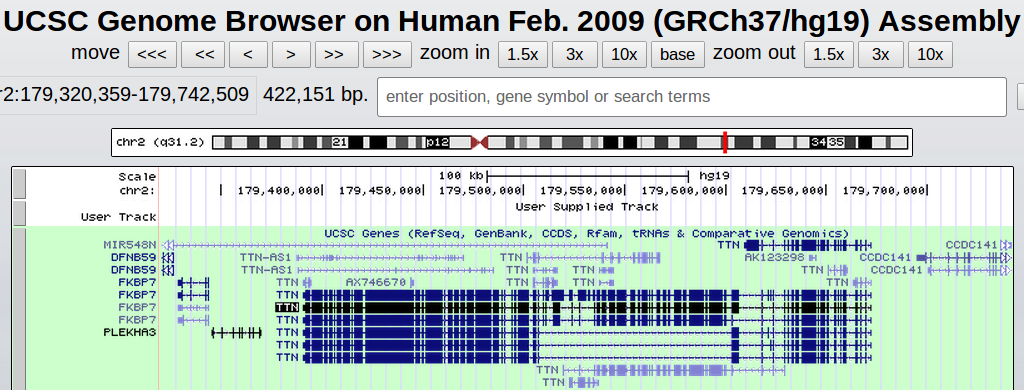
Just curious, which gene has the longest transcript?
mysql> select chrom, name, name2, txEnd-txStart AS span from refGene order by span DESC limit 10;
+-------+--------------+--------------+---------+
| chrom | name | name2 | span |
+-------+--------------+--------------+---------+
| chr1 | NM_001278267 | LOC100288142 | 2320934 |
| chr7 | NM_014141 | CNTNAP2 | 2304636 |
| chr9 | NM_002839 | PTPRD | 2298478 |
| chrX | NM_000109 | DMD | 2220382 |
| chr11 | NM_001142699 | DLG2 | 2172259 |
| chrX | NM_004006 | DMD | 2092329 |
| chr8 | NM_033225 | CSMD1 | 2059454 |
| chr20 | NM_080676 | MACROD2 | 2057696 |
| chrX | NM_004009 | DMD | 2009201 |
| chrX | NM_004010 | DMD | 2009200 |
+-------+--------------+--------------+---------+
10 rows in set (0.40 sec)
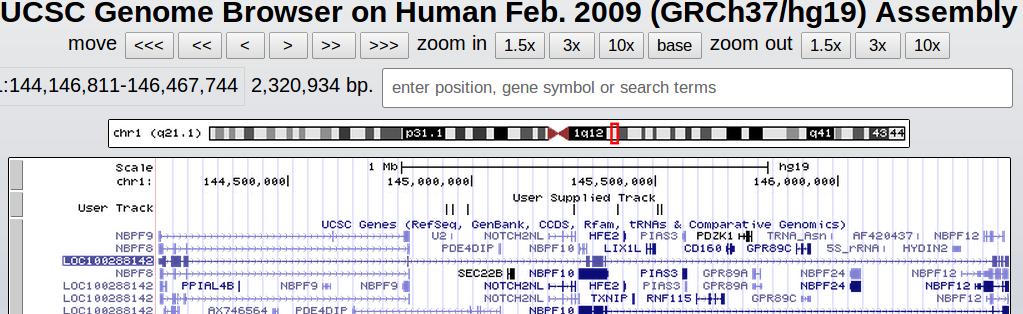
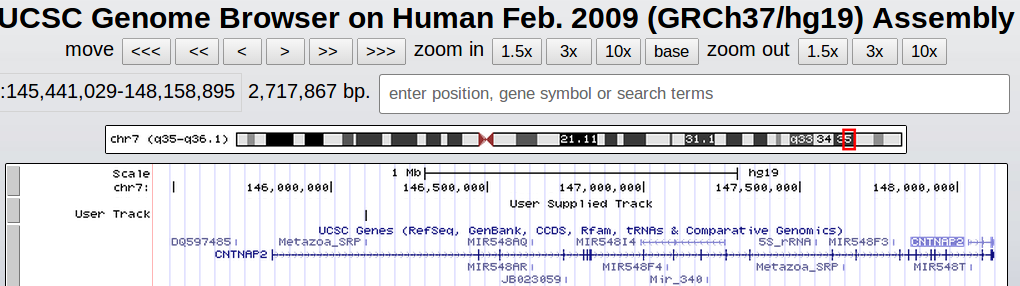
These two genes span more than 2Mb!
of course, one can download the refGene table to local computer and use awk etc to do this kind of work, but I just see how powerful and convenient mysql is especially when you have multiple tables and want to do some summarization across them.