I promised to write about bubble sort and merge sort in my previous blog define a python function--- find the biggest number of a list
Finally, I got some time to write it. My undergraduate helped me to do some molecular cloning stuff today, I guess I will be too lazy to do bench work :)
The examples I am going to use are from the MIT open course lecture 9 and 10
http://ocw.mit.edu/courses/electrical-engineering-and-computer-science/6-00-introduction-to-computer-science-and-programming-fall-2008/video-lectures/lecture-9/
The question is that you have a list of numbers, and how do you sort it from small to big.
I will lay down the python code first.
A trick....I copied (M-w) the code from my emacs editor and tried to paste (ctrl-v) in the blog, but it did not work. In fact, click the middle mouse button did the trick :)
# a demonstration of buble sort and merge sort, p is a list of integers
# for bubble sort swap the values if p[i+1] < p[i]
def bubblesort(p):
for j in range(len(p)):
for i in range(len(p)-1):
if p[i] > p[i+1]:
temp = p[i]
p[i] = p[i+1]
p[i+1] = temp
return p
# for bubble sort, we can do better, when there is no swap, we stop the for loop
def bubblesort2(p):
swapped = True
while swapped:
swapped = False
for i in range(len(p)-1):
if p[i] > p[i+1]:
temp = p[i]
p[i] = p[i+1]
p[i+1] = temp
swapped = True
return p
# divide and conqure method merge-sort
# divide the list in half, continue until we have single list, merge sub-lists
def mergesort(p):
# print p
if len(p) < 2 :
return p[:]
else:
middle = len(p) / 2
left = mergesort(p[:middle]) # this is the beauty of recursion, further break down the list to smaller lists
right =mergesort(p[middle:])
together = merge(left, right)
#print "merged", together
return together
# now we need to define the merge function, this function merges two sorted lists of numbers.
def merge(left, right):
result = []
i,j = 0,0
while i < len(left) and j < len(right):
if left[i] <= right[j]:
result.append(left[i])
i = i+1
else:
result.append(right[j])
j = j+1
while i< len(left):
result.append(left[i])
i = i + 1
while j < len(right):
result.append(right[j])
j = j + 1
return result
The code above is pretty self-explanatory.
for bubblesort, we have a nested loop, the inner loop put the biggest number to the end of the list every time when execute the outer loop.
bubblesort2 uses a variable "swapped" to track if there is any swap occurs. if no swap occurs, the list is already pre-sorted, quit the loop. return the result.
mergesort splits the list into smaller sub-list until only single number list. Then, we merge back the sorted list into a big list.
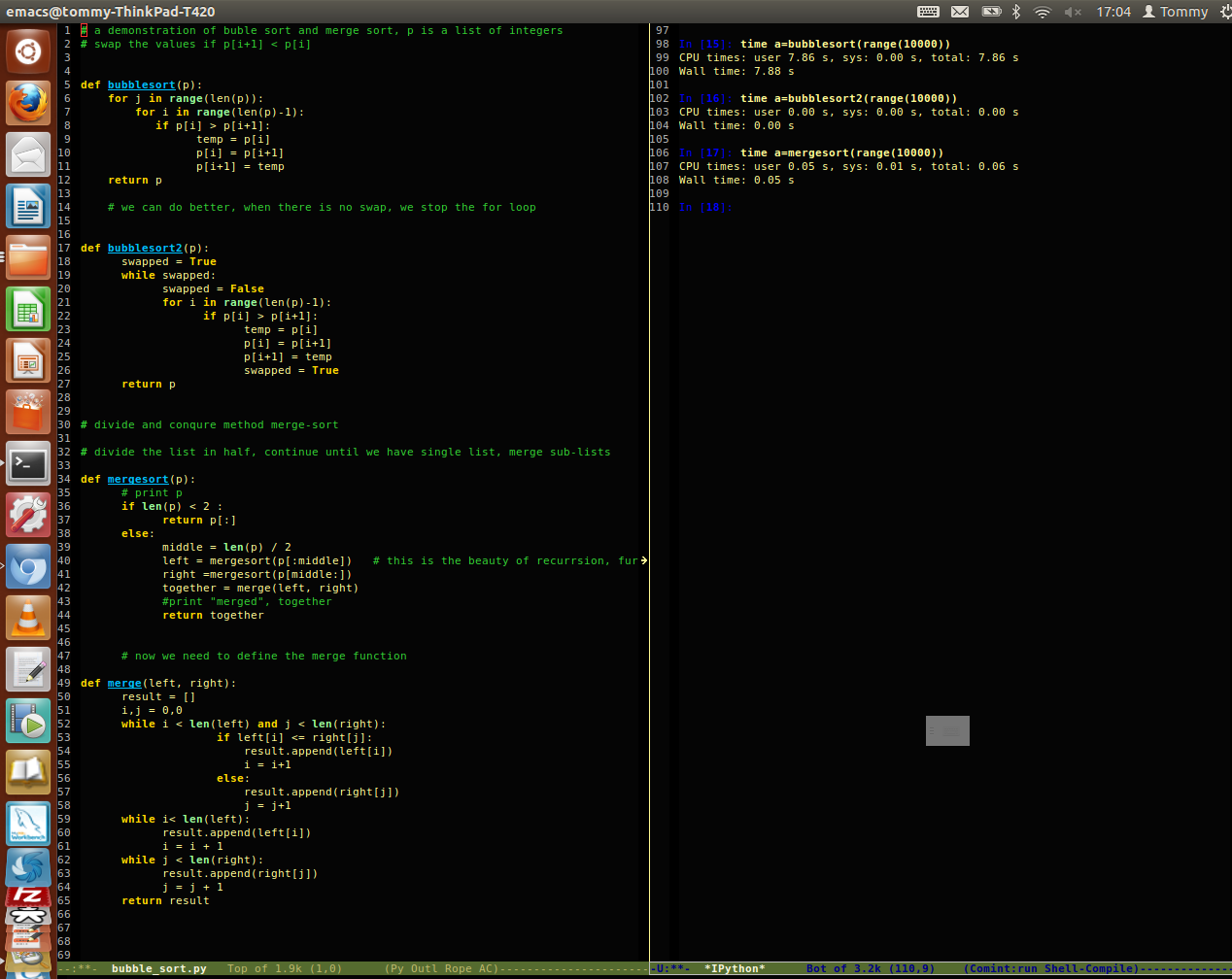
Let's have a look at the performance of these three functions by Ipython's magic function %time
In [15]: time a=bubblesort(range(10000))
CPU times: user 7.86 s, sys: 0.00 s, total: 7.86 s
Wall time: 7.88 s
In [16]: time a=bubblesort2(range(10000))
CPU times: user 0.00 s, sys: 0.00 s, total: 0.00 s
Wall time: 0.00 s
In [17]: time a=mergesort(range(10000))
CPU times: user 0.05 s, sys: 0.01 s, total: 0.06 s
Wall time: 0.05 s
in this particular test, I generated a list of range(10000): [0,1,2,3,4,5......999]
you will see bubblesort took the longest time, because it is not aware that the list is already pre-sorted.
bubblesort2 caught that and return the result instantly.
performance of mergesort is also decent. If we had a not pre-sorted list, the mergesort would out-perform the bubblesort2.
Finally, I want to show off my Emacs python editor :)